
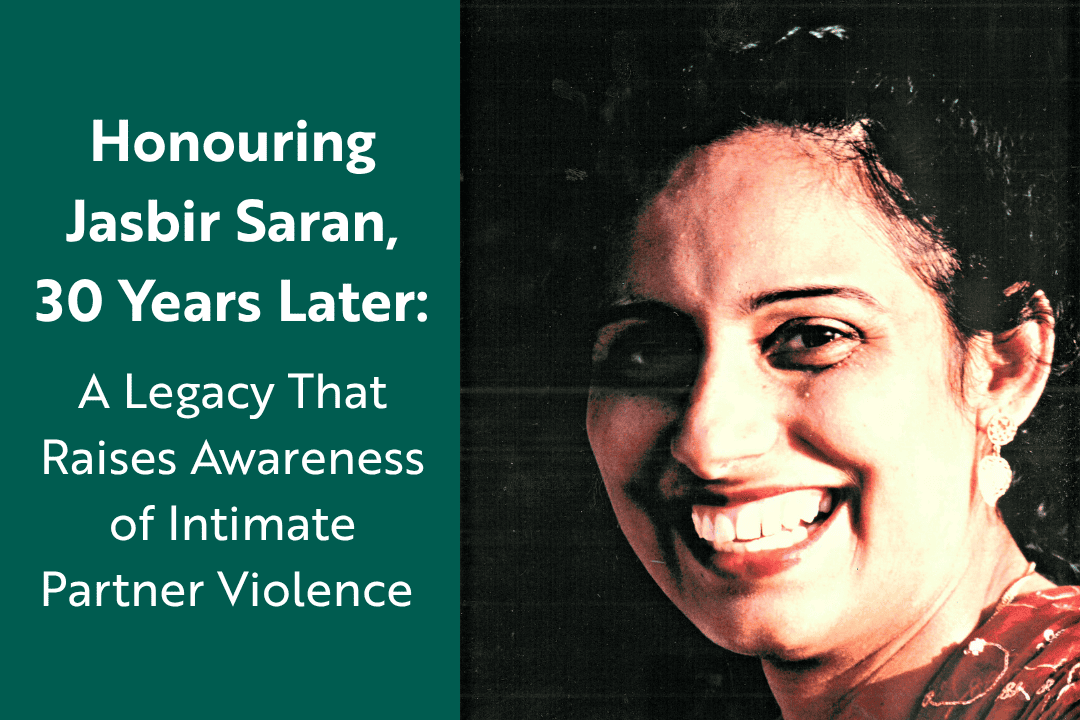
Jasbir Saran, along with her husband, parents and all five siblings, were gunned down by an estranged family member in their family home as they prepared for her sister’s wedding. Jasbir and her husband Roger left behind three young children, including twin daughters, one of which was injured in both legs by a stray bullet.
Thirty years later, Jasbir is remembered not only for the heartbreaking circumstances surrounding her death, but for the kindness and dedication she brought to her work at Archway. Her story also serves as a reminder of the continued importance of raising awareness about intimate partner violence.
A Dedicated Leader Supporting Newcomers
Manpreet Grewal, now the executive director of programs and services at Archway, worked with Jasbir during those early years.
“She was very hardworking and had a great way with clients,” Manpreet recalled. “When she was at work, she was empathetic and focused on helping them. When we were in the process of expanding and formalizing LINC, she was very methodical and procedural about making sure everything was done properly.”
Beyond her administrative role, Jasbir helped build a welcoming community around the program. Teachers and students regularly gathered for potlucks and celebrations, creating a sense of belonging for newcomers building new lives in Canada.
“She was very social and hospitable and loved bringing people together,” said Manpreet.
Rossana Chisholm, now a LINC supervisor at Archway, worked under Jasbir for several years and remembers her as a supportive and approachable leader.
“She was very warm and friendly,” Rossana recalled. “She made time to connect with her staff and would come to class celebrations and achievements.”
When Rossana first interviewed for a teaching assistant position, she had recently immigrated to Canada and didn’t yet have family nearby to help with childcare.
“I had to bring my two-year-old with me to the interview,” Rossana said. “It was my first interview in Canada and we had no family to babysit, but she was very accepting of it. I was pleasantly surprised when I was offered the job.”
Lukhvinder Aujla, who worked near Jasbir at the time as a practicum student and is now supervisor of the Archway Specialized Victim Assistance Program, remembers her warmth and authenticity.
“My first impression of her was that she had this genuine laugh,” Lukhvinder recalled. “She laughed so openly. She was a very humble person and always wanting to help people. She was easy to talk to, someone you felt you could tell anything to.”
Supporting Women Facing Violence
Many clients initially came seeking help with everyday needs – filling out forms, applying for documents, or navigating services – but as trust developed, deeper concerns often surfaced.
“Clients would say, ‘Can I talk to you about something?’” Manpreet explained. “And then the stories would come out about what was happening at home. Our role was to listen, help them understand what their options are, and connect them to support.”
Many newcomers arrive in Canada without extended family or support systems, and some experience deep isolation. For some women, simply sharing what is happening at home is the first step toward recognizing that abuse is not something they have to endure.
At Archway, staff help women understand their options – connecting them to transition houses, legal services, social assistance, and counselling supports. Programs like Specialized Victim Assistance are an important part of the community response.
Honouring Jasbir’s Legacy
In the years following her death, Archway sought ways to honour Jasbir’s memory and the contributions she made to the organization.
A tree was planted in her honour – which still stands today – and a meeting room was named after her at the Montrose location.
“She spent a lot of time in that room,” Lukhvinder recalled. “They would hold celebrations there for students – Christmas parties, activities for families, and events where students and their children could come together.”
Years later, two of her daughters – twins who were very young at the time of the tragedy –volunteered at Archway, quietly carrying forward their mother’s connection to the organization.
Walter Paetkau, the Archway executive director at the time of her death, also honoured Jasbir’s memory with a poem to recognize the profound impact Jasbir’s loss had on the organization.
“It was a very significant blow,” he said. “It caught us all off guard. For a while, I think we were all in a bit of a fog trying to process what had happened.”
The poem was later published in Walter’s book It Takes Raindrops to Fill a Lake (2019), a retrospective of the agency’s first 50 years.
In Memorium
JASBIR SARAN
The gun is silent now. And violence weeps for peace.
Kelowna, April 5, 1996
Short months ago,
A year,
She walked our halls.
Laughed with us.
Worked with us.
Felt the same sun.
Knew the driving rain.
Loved and was loved.
She is memory now.
For each
A thought,
A prayer,
A word remembered.
Ever absent.
Ever present.
A tree
Stands in her memory.
Roots drawing life
From the good earth.
Life
Feeding the spreading branches
And sunlit leaves
She was that to us:
Roots.
Life.
Light.
A door opens in her memory;
To a room filled with people.
People of many nations
And languages.
People eager to learn,
To sing,
To dance,
To laugh together,
To be together.
She was that with us:
Culture.
Learning.
Being.
Walk gently in her path.
For violence weeps for peace.
Poem by Walter Paetkau
Abbotsford, April 4, 1997
In dedication of the Coral Bark Maple and the Jasbir Saran Room
Continuing the Work
Today, Archway continues to support individuals and families experiencing intimate partner violence through programs like, Courtyard for Men, Stopping the Violence and the Specialized Victim Assistance Program.
Staff across the organization are often among the first people survivors speak to about what they are experiencing. Their role is not to force decisions, but to ensure individuals know they are not alone and that support exists.
“Intimate partner violence can happen to anyone, regardless of socio-economic status or education,” said Lukhvinder.
If someone comes forward experiencing abuse, staff work with them to understand their situation and discuss possible next steps. This may include safety planning, connecting with counselling, accessing legal information, or helping someone safely leave a dangerous environment.
“Sometimes people are not ready to report to police, and that’s okay,” Lukhvinder explained. “We meet people where they are. We give them information, help them think about safety, and support them in whatever decision they make.”
For individuals who may be isolated – particularly newcomers – group programs play an important role.
Archway facilitates support groups for Punjabi-speaking women experiencing intimate partner violence. The program creates a safe space where women can get support from a therapist, learn practical skills, and build social connections.
“For some women, it might be the first time they’ve had a chance to talk openly about what they’re going through,” Lukhvinder said. “And sometimes they leave those groups with friendships and support systems that continue long after the program ends.”
Reaching Out for Help
Support can include:
- Connecting with local victim services
- Accessing transition housing and safety planning
- Legal support and protection orders
- Counselling and community services
Remembering Jasbir
“She was fun, social, and deeply committed to helping others,” Manpreet said.
Thirty years later, her legacy continues in the programs she helped grow, the lives she touched, and the ongoing work to support survivors of intimate partner violence in the community.
“Remembering Jasbir brings back memories of her contribution and her leadership,” Walter said. “She was very professional and very well respected by the staff who worked with her.”